How to Choose the Right Cosmetic Packaging Box?
Choosing the right Cosmetic Packaging Box is not just a matter of picking an attractive color. The box must protect the product, fit its shape, and communicate the brand clearly. A glass serum bottle needs a snug insert; a lightweight cream jar may need less cushioning. Small details matter. A loose fit can make a premium product feel careless, even before the customer opens it.
Cosmetic packaging specialist Elena Morris offers this useful principle: “A good box protects the product, tells its story, and feels right in the customer’s hands.” Use that as a starting point, not a rigid rule. The best choice depends on your product, budget, shipping conditions, and intended audience. A glossy finish may catch the light on a retail shelf, while a simple matte surface can feel more understated. Neither is automatically better. There are trade-offs.
This guide explores how to compare materials, dimensions, printing, finishes, and protective features. It also considers sustainability and practical costs, because attractive packaging can still be wasteful or difficult to assemble. Ask how the box behaves after repeated handling. Check whether the insert keeps the product steady. Test a sample before placing a large order. That step takes time. It can reveal awkward openings, scuffed corners, or a box that looks different under store lighting. Some choices will still be imperfect. The aim is to make informed decisions that protect the product and support a consistent customer experience.
Define Box Dimensions from Product Size, Fit, and Retail Display Requirements
How to Choose the Right Cosmetic Packaging Box?
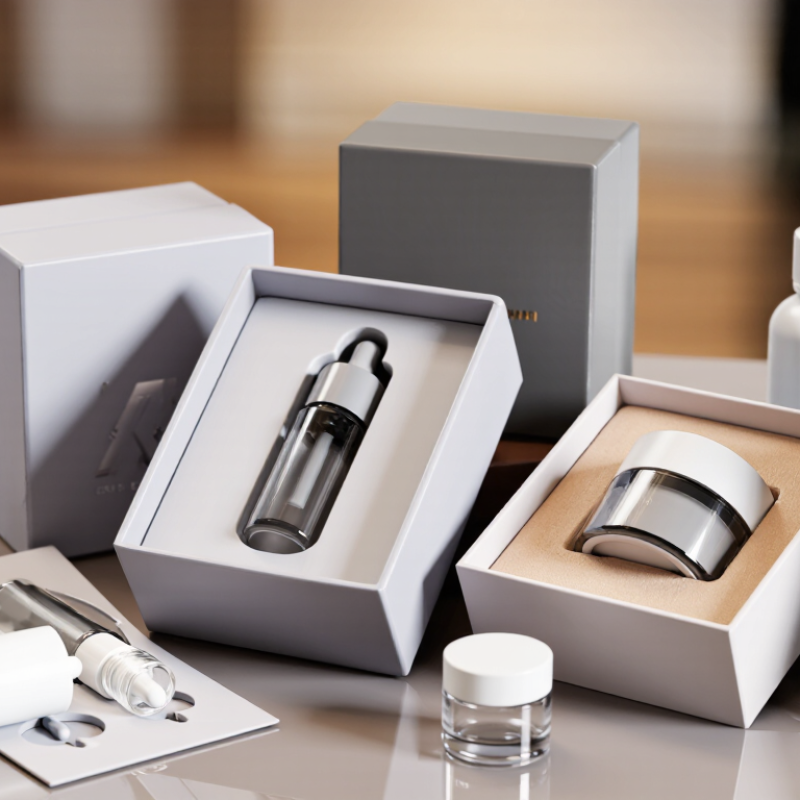
A cosmetic box should protect the product without turning empty space into a hidden cost. Measure the bottle, cap, pump, and insert at their widest points. Record the product’s height with its closure fitted; pumps and droppers can change the overall profile. Allow enough clearance for easy removal, but avoid a loose rattle. Measure twice.
Start with the product’s actual dimensions, then test a snug fit using a simple mock-up. A glass serum bottle may need cushioning around its shoulders, while a flat palette needs corner protection. The box should close without pressing the cap or bowing its panels.
The U.S. EPA’s 2018 Advancing Sustainable Materials Management report estimated that packaging and containers made up 82.2 million tons of U.S. municipal solid waste. They represented 28.1% of the total.
Right-sizing can help avoid unnecessary material. For retail, check the front-facing width, label visibility, and stability beside neighboring boxes. A display tray may need a wider footprint than a shipping carton. Do not trust a screen rendering alone. Shelf tests can reveal awkward proportions your measurements missed. One prototype may still need revision.
Select Board Weight and Thickness Using ISO 536 and ISO 534
How to Choose the Right Cosmetic Packaging Box?
Select Board Weight and Thickness Using ISO 536 and ISO 534
A cosmetic box must protect its contents and feel right in the hand. Start by specifying board grammage in grams per square metre (g/m²), measured using ISO 536. Then check thickness, or caliper, using ISO 534. These measurements are related, but they are not interchangeable. Grammage describes mass per area; caliper affects fold feel, insert fit, and the height of a packed stack. CEPI’s Key Statistics 2023 reported 79.3 million tonnes of paper and board production in Europe. That industry scale makes clear why precise, repeatable specifications matter, though it does not tell you which grade suits your box.
Compare samples at the same specified grammage and caliper. Check how each board folds around a sharp corner, holds a tuck flap, and supports the product during handling. A thicker sheet is not automatically stronger: fibre composition, coating, grain direction, and converting quality also matter. A clean laboratory reading may still disappoint on the packing line. Test finished boxes, not just flat sheets, and record the conditions used for measurement.
Tips: Request supplier test results for ISO 536 and ISO 534, then verify samples under consistent conditions. Check fit with the actual insert and product. Small differences matter.
How to Choose the Right Cosmetic Packaging Box? — Select Board Weight and Thickness Using ISO 536 and ISO 534
Use grammage and thickness together when comparing candidate boards. The figures below are indicative examples for initial material selection, not grade specifications or limits set by ISO.
| Board Type |
Indicative Grammage
(g/m²) |
Indicative Thickness
(µm) |
Potential Cosmetic-Box Use |
Selection Considerations |
| Solid bleached board (SBB/SBS) |
250 |
300–380 |
Small cartons for lightweight skincare or makeup products |
Offers a smooth, bright surface for printing. Check that the finished carton provides enough stiffness for the product and closure style. |
| Solid bleached board (SBB/SBS) |
300 |
360–450 |
General-purpose folding cartons for creams, palettes, and boxed personal-care items |
A common starting point for balancing print quality, foldability, and carton rigidity. Actual performance depends on board construction and grain direction. |
| Solid bleached board (SBB/SBS) |
350 |
420–520 |
Larger cartons or packs needing a more substantial feel |
Higher grammage can add substance, but may require adjustments to creasing, folding, and die-cutting. |
| Folding boxboard (FBB) |
250 |
400–550 |
Lightweight folding cartons where board bulk is useful |
Its multi-layer construction can provide greater thickness at a similar grammage than some solid boards. Compare samples rather than relying on grammage alone. |
| Folding boxboard (FBB) |
300 |
480–650 |
Mid-sized cosmetic cartons requiring added bulk and stiffness |
Confirm that the selected caliper works with the carton’s folds, locking tabs, and any product insert. |
| Recycled folding boxboard |
300 |
450–650 |
Everyday retail cartons where recycled fibre content is a material priority |
Surface appearance, shade, stiffness, and thickness can vary between grades. Evaluate the actual printed and converted board. |
| Rigid boxboard |
800 |
900–1,300 |
Rigid presentation boxes for gift sets or premium product kits |
Typically used as a thick structural substrate rather than a folding-carton material. Check wrapping, corner formation, and finished-box dimensions. |
Assess Print, Coatings, and Finishes for Cosmetic Product Compatibility
How to Choose the Right Cosmetic Packaging Box?
Cosmetic cartons must protect their appearance through filling, shipping, and repeated handling. Match print and finishes to both the formula and the primary container. A glossy carton can show fingerprints; a soft-touch coating may scuff under friction. Foil and heavy lamination can also complicate recycling, so use them only where they add clear value. Check ink adhesion, color consistency, rub resistance, and odor on the actual board stock. Small test. Then test again after folding.
Compatibility is easy to overlook. Oils or fragrance near a carton can soften coatings or leave marks, while tight folds may crack a brittle varnish. Test finished samples beside the real container, under warm, humid storage, and after abrasion. For direct-contact components, assess materials separately with qualified packaging specialists. McKinsey and NielsenIQ’s 2023 analysis found that US consumer products with ESG-related claims had 28% cumulative sales growth over five years, versus 20% for products without such claims. That finding does not prove a finish drives sales, but it supports making sustainability claims carefully. Verify recyclability with the chosen material and local recovery stream; a “paper look” alone proves little. One practical trade-off: the most tactile finish may not be the easiest to recycle.
Test Shipping Durability with ASTM D642 and ISTA 3A Protocols
A cosmetic packaging box may look sturdy on a shelf and still fail in transit. Corners crush. Glass bottles shift. The U.S. Census Bureau reported that e-commerce accounted for 16.1% of U.S. retail sales in 2024, making parcel protection a practical design concern. That figure does not predict damage rates, but it shows how often products rely on shipping-ready packaging.
Use ASTM D642 to measure how much compressive force a box can withstand. Test the finished pack, not just a flat board sample: include the actual bottle, insert, closure, and wrapping. Watch for bowed panels, crushed corners, or a lid that starts to lift. Then use ISTA 3A, a parcel-delivery simulation for individual packaged products, to assess hazards such as drops and vibration. Follow the current protocol and select the test configuration that matches the shipment.
Check the box afterward. Look for leaks, scuffed labels, shifted inserts, and subtle cracks around bottle shoulders. A package can pass a compression test yet fail after repeated movement. Lab tests help compare designs; they cannot perfectly reproduce every route, carrier, or weather condition. That limitation matters. Record the test setup, conditioning, and observed failures, then adjust the box and retest. Sources: ASTM D642, Standard Test Method for Determining Compressive Resistance of Shipping Containers; ISTA 3A; U.S. Census Bureau, 2024 Annual Retail Trade Survey.
How to Choose the Right Cosmetic Packaging Box?
ISTA 3A standard drop heights vary by packaged-product weight. Use this profile to understand the drop-test severity for your shipment; confirm the applicable procedure and current requirements before testing.
How to apply this: Use ASTM D642 to evaluate a shipping container’s resistance to externally applied compression. Use the applicable ISTA 3A procedure to assess parcel-distribution hazards, including drops. ASTM D642 does not prescribe one universal pass load; set acceptance criteria for the specific box, contents, and shipping conditions. Drop heights shown are in inches.
Reference: ISTA 3A packaged-product drop-height schedule and ASTM D642 test scope. Verify details against the current standards and the package category being tested.
Check EU PPWR Recyclability Requirements Taking Effect in 2030
Choosing a cosmetic box now means checking more than shelf appeal. Under the EU Packaging and Packaging Waste Regulation (PPWR), packaging must meet recyclability requirements from 2030. The regulation sets a direction toward packaging designed for material recycling, with performance grades to assess recyclability. For a cosmetic carton, inspect the whole pack: paperboard, plastic windows, foil stamping, coatings, and glued inserts. A box that looks like paper may be harder to sort if layers cannot be separated. Small choices matter. A simple, uncoated board with minimal mixed materials is often easier to recycle, but actual performance depends on local collection and sorting systems.
The scale of the issue is clear. Eurostat reported 186.5 kilograms of packaging waste per EU resident in 2022; plastic packaging recycling stood at 41%. OECD’s Global Plastics Outlook found that only 9% of global plastic waste was recycled in 2019. These figures make material choices more than a design detail. Ask suppliers for component-level material data and evidence that inks, adhesives, and finishes are compatible with recycling processes. Do not rely on a “paper-based” label alone. I would still test the finished box with a recycler, because a neat specification sheet cannot reveal every sorting problem. That extra check can feel inconvenient, but overlooking a small plastic window or laminated panel may undermine the box’s recyclability.